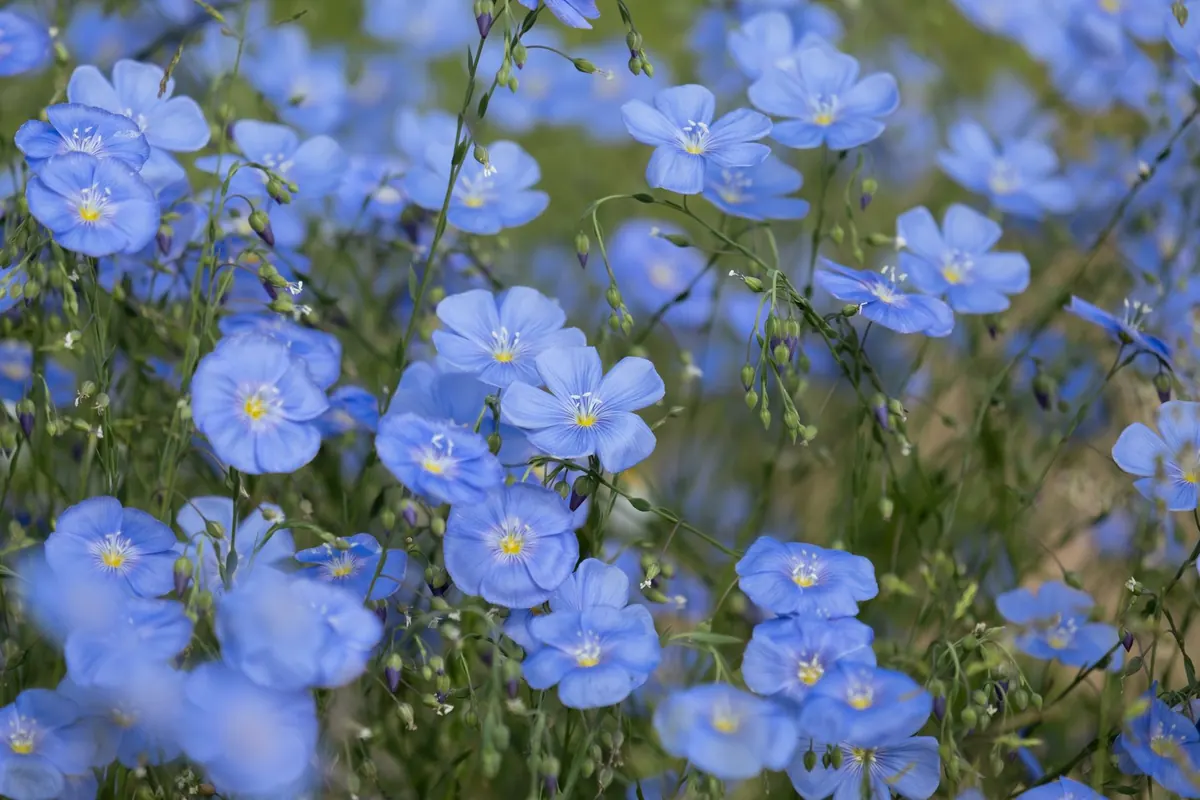
Linen and cotton sit close together on the shelf: both plant fibres, both breathable, both a pleasure in a heatwave. Look at how each is grown and made, though, and they part company quickly.
The short answer is that linen usually has the lighter footprint, and that has less to do with the fibre than with the plant behind it. Flax grows well in cool, damp climates and asks relatively little of the land. Cotton is a thirstier, more pest-prone crop, often grown in places where water is already stretched.
That advantage is real, but it is not unconditional. A linen-viscose blend washed hot twice a week is no environmental bargain. Here is what actually separates the two, and how to choose well.
Linen is made from flax, a slender plant grown mainly in northern France, Belgium, the Netherlands and parts of eastern Europe. It is sown thickly, and those dense stands shade out weeds, so there is less need to spray. In its main growing regions it generally relies on rainfall rather than irrigation. Flax also sends down a long taproot that opens up the soil, and it is usually grown in rotation with wheat, sugar beet or potatoes, which helps break pest and disease cycles. Very little goes to waste: the seed becomes linseed oil and animal feed, the woody core goes into board and bedding, and the fibre becomes cloth.
Cotton is a different proposition. It is a shrub grown in warm climates, often in rows, and it is vulnerable to a long list of insects and diseases. That does not make cotton a villain. Rain-fed cotton grown in rotation can be a sound crop. But the conventional version, especially where irrigation is the only way to keep it alive, carries a heavier environmental tab.
Growing cotton can take a great deal of water, and in some regions it is pumped from rivers and aquifers faster than they refill. The shrinking of the Aral Sea in Central Asia is the most documented example: irrigation-heavy cotton farming there diverted the rivers that fed it. Irrigation also tends to draw salts to the surface, which can leave soil too salty to farm.
Flax in its main growing regions mostly gets its water from the sky, which is one reason linen's water footprint is usually lower. The complication comes later, at the retting stage, when the fibre is separated from the stem. Dew retting leaves the stalks in the field and lets moisture and microbes do the work. Water retting uses tanks of water, and if that water is discharged untreated it can pollute local rivers. Much European flax is now dew-retted, but it is a fair question to ask a supplier which method they use.
Conventional cotton has historically accounted for a disproportionate share of global insecticide use relative to the land it occupies, which follows from growing a pest-prone crop at scale. Flax's dense sowing and cooler growing conditions mean it typically needs far fewer chemical inputs, though it is not automatically organic. It can still be grown with fertiliser and herbicides, particularly in higher-yield systems.
Labels are the quickest way to check what you are buying:
For either fibre, organic matters most where soil and water are concerned. Healthy soil holds moisture better, which is why organic cotton generally needs less irrigation than the conventional kind.
Here is the measure that rarely makes a headline: how many times you wear something. Linen is a bast fibre, taken from the stem of the plant, and its long fibres stay strong even when wet. It softens with washing instead of wearing out, and a well-made linen shirt or set of sheets can stay in use for years, sometimes passing between generations. It mends beautifully too — a darned linen shirt reads as deliberate rather than damaged — and pure linen will biodegrade at the end of its life.
Cotton can be just as durable, but quality varies enormously. Long-staple cottons such as Egyptian or Pima hold up well. The short-staple cotton in a cheap t-shirt tends to pill, thin and lose shape within a season or two. That difference is the whole argument in miniature: a garment you keep for a decade beats a cheaper one you replace every year, whatever the fibre.
Linen is not automatically the greener choice. Four things are worth checking.
Buy less, choose well, look after it. A simple approach:
So the comparison is less linen versus cotton than it is things you will use for years versus things you will not. Linen tends to win on water, pesticides and longevity — but only if you buy it to keep, and treat it that way.
Photo: Ilo Frey / Pexels
A practical guide to visible mending, patching and cutting down worn linen sheets — plus simple projects that turn...
A practical guide to common linen weaves — plain, twill, herringbone, basket, sateen and huckaback — explaining how...
How to pair linen curtains with cottages, Georgian rooms and Victorian terraces — choosing colours, linings and...

Celebrating the beauty and versatility of linen..
